
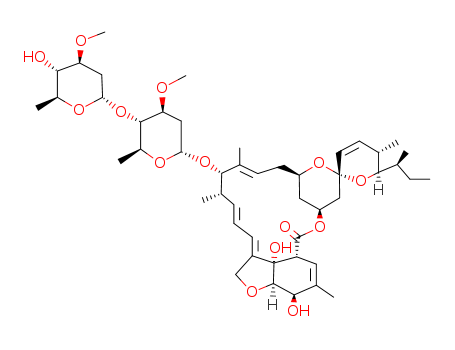
Avermectin B1a
- CasNo:65195-55-3
Product Description
Factory Sells Best Quality Avermectin B1a 65195-55-3 with steady supply
- Molecular Formula:C48H72O14
- Molecular Weight:873.091
- Appearance/Colour:white crystalline powder
- Vapor Pressure:0mmHg at 25°C
- Melting Point:157-162oC
- Refractive Index:1.571
- Boiling Point:940.912 °C at 760 mmHg
- PKA:12.42±0.70(Predicted)
- Flash Point:268.073 °C
- PSA:170.06000
- Density:1.244 g/cm3
- LogP:5.37740
Avermectin B1a(Cas 65195-55-3) Usage
|
Manufacturing Process |
1. The contents of a lyophilized tube of Streptomyces avermitilis MA-4680 is transferred aseptically to a 250 ml Erlenmeyer flask containing 305 ml of Medium 1: Dextrose 20 g, Peptone 5 g, Meat Extract 5 g, Primary Yeast 3 g, NaCl 5 g, CaCO3 (after pH adjustment) 3 g, Distilled water 1000 ml, pH 7.0. The inoculated flask is incubated for 3 days at 28°C on a rotary shaking machine at a speed of 220 RPM in a 2 inch radius circular orbit. At the end of this time, a 250 ml Erlenmeyer flask containing 50 ml of Medium 2 [Tomato Paste 20 g, Modified Starch (CPC) 20 g, Primary Yeast 10 g, CoCl2·6H2O 0.005 g, Distilled water 1000 ml, pH 7.2-7.4] is inoculated with a 2 ml sample from the first flask. This flask is incubated for 3 days at 28°C on a rotary shaking machine at a speed of 220 RPM in a 2 inch diameter circular orbit. 50 Ml of the resulting fermentation broth containing C-076 is effective against an N.dubius infection in mice.2. A lyophilized tube of Streptomyces avermitilis MA-4680 is opened aseptically and the contents suspended in 50 ml of Medium 1 in a 250 ml Erlenmeyer flask. This flask is shaken for 3 days at 28°C on a rotary shaking machine 220 RPM with a 2 inch diameter circular orbit. A 0.2 ml portion of this seed medium is used to inoculate a Slant of Medium 3: Dextrose 10.0 g , Bacto Asparagine 0.5 g, K2HPO4 40.5 g, Bacto Agar 15.0 g , Distilled water 1000 ml, pH 7.0. The inoculated slant medium is incubated at 28°C for 10 days and stored at 4°C until used to inoculate 4 more slants of Medium 3. These slants are incubated in the dark for 8 days. One of these slants is used to inoculate 3 baffled 250 ml Erlenmeyer flasks containing 50 ml of No. 4 Seed Medium: Soluble Starch 10.0 g, Ardamine 5.0 g, NZ Amine E 5.0 g, Beef Extract 3.0 g, MgSO4·7H2O 0.5 g, Cerelose 1.0 g, Na2HPO4 0.190 g, KH2PO4 182 g, CaCO3 0.5 g, Distilled water 1000 ml, pH 7.0-7.2. The seed flasks are shaken for 2 days at 27-28°C on a rotary shaking machine at 220 RPM with a 2 inch diameter circular orbit. The contents of these flasks are pooled and used to inoculate (5% inoculum) baffled 250 ml Erlenmeyer flasks containing 40 ml of various production media. Flasks containing media 2, 5 and 6 are incubated for 4 days at 28°C on a rotary shaking machine at 220 RPM with a 2 inch diameter circular orbit. The resulting broth containing C-076 is then harvested and tested for anthelmintic activity. In all cases 6.2 ml of whole broth and the solids obtained from centrifuging 25 ml of whole broth are fully active against N.dubius helminth infections in mice.3. The one of the four slants of Medium 3 prepared as in Example 2 is used to inoculate a baffled 250 ml Erlenmeyer flask containing 50 ml of Seed Medium No. 4. The seed flask is shaken for 1 day at 27- 28°C on a rotary shaking machine at 220 RPM with a 2 inch diameter circular orbit. The seed flask is then stored stationary at 4°C until it is ready to be used. The contents of this flask are then used to inoculate (5% inoculum) 20 unbaffled 250 ml Erlenmeyer flasks containing 40 ml of Medium No. 2. After 4 days incubation at 28°C on a rotary shaking machine at 220 RPM with a 2 inch diameter circular orbit, 19 of the flasks are harvested and pooled. The combined fermentation broths containing C-076 are filtered affording 500 ml of filtrate and 84 g of mycelia. 78 G of mycelia are extracted with 150 ml of acetone for ? hour with stirring and the mixture filtered. The filter cake is washed with 50 ml of acetone and the filtrate and washings are combined and concentrated to 46.5 ml 30 Ml of the concentrate is adjusted to pH 4 with dilute hydrochloric acid and extracted 3 times with 30 ml portions of chloroform. The extracts are dried by filtering through dry Infusorial Earth (Super-Cel) combined and concentrated to dryness in vacuum. The oily residue of C-076 weighing 91.4 mg is dissolved in chloroform sufficient to make 3 ml of solution which represents 1% of broth volume. The C-076 (Abamectin) obtained in this recovery procedure is fully active against N.dubius infections in mice. In addition, the chloroform extraction achieved a 70 fold purification of C-076 from the whole broth. |
|
Therapeutic Function |
Antiparasitic |
|
Safety Profile |
A poison by ingestion.Moderately toxic by skin contact. When heated todecomposition it emits acrid smoke and irritating fumes. |
InChI:InChI=1/C48H72O14/c1-11-25(2)43-28(5)17-18-47(62-43)23-34-20-33(61-47)16-15-27(4)42(26(3)13-12-14-32-24-55-45-40(49)29(6)19-35(46(51)58-34)48(32,45)52)59-39-22-37(54-10)44(31(8)57-39)60-38-21-36(53-9)41(50)30(7)56-38/h12-15,17-19,25-26,28,30-31,33-45,49-50,52H,11,16,20-24H2,1-10H3/b13-12+,27-15-,32-14-/t25-,26-,28-,30-,31-,33+,34-,35-,36-,37-,38-,39-,40+,41-,42-,43+,44-,45+,47+,48+/m0/s1
65195-55-3 Relevant articles
CHEMICAL DEGRADATION OF AVERMECTIN B1
Blizzard, Timothy A.,Mrozik, Helmut,Fisher, Michael H.
, p. 3163 - 3166 (1988)
Chemical degradation of avermectin B1 (1...
A methylamino avermectin key intermediate catalytic synthesis process (by machine translation)
-
Paragraph 0025; 0027; 0031; 0033; 0034; 0036, (2019/01/23)
The invention relates to a pesticide int...
A novel synthesis of avermectin B(1a) from avermectin B(2a)
Katoh, Tadashi,Itoh, Etsuko,Terashima, Shiro
, p. 587 - 590 (2007/10/03)
The title synthesis was achieved via a f...
24-and 25-substituted avermectin and milbemycin derivatives
-
, (2008/06/13)
Novel avermectin and milbemycin derivati...
Total synthesis of the antiparasitic agent avermectin B1a
White, James D.,Bolton, Gary L.,Dantanarayana, Anura P.,Fox, Christina M. J.,Hiner, Roger N.,Jackson, Randy W.,Sakuma, Kazuhiko,Warrier, Ulhas S.
, p. 1908 - 1939 (2007/10/02)
The synthesis of avermectin B1a has been...
65195-55-3 Process route
-
-
81924-42-7
4'',5-bis

-
-
65195-55-3
avermectin B1a
| Conditions | Yield |
|---|---|
|
With
(HF)n*Py;
In
acetonitrile;
at 20 ℃;
for 14h;
|
69% |
|
With
pyridine hydrogenfluoride;
In
pyridine; acetonitrile;
for 30h;
Ambient temperature;
|
64% |
|
Multi-step reaction with 4 steps
1: 93 percent / DBU / CH2Cl2 / 16 h / Ambient temperature
2: 96 percent / triethylamine, 4-DMAP / CH2Cl2 / 1.) 0 deg C, 1 h, 2.) room temperature, 24 h
3: 1.) LDA, trimethylsilyl chloride, 2.) 2N HCl / 1.) THF, -78 deg C, 2 min, 2.) THF, H2O, room temperature, 3 h
4: 48percent aqueous HF, pyridine / acetonitrile / Ambient temperature
With
pyridine; hydrogenchloride; dmap; chloro-trimethyl-silane; hydrogen fluoride; 1,8-diazabicyclo[5.4.0]undec-7-ene; triethylamine; lithium diisopropyl amide;
In
dichloromethane; acetonitrile;
|
|
|
Multi-step reaction with 6 steps
1: 93 percent / DBU / CH2Cl2 / 16 h / Ambient temperature
2: 96 percent / triethylamine, 4-DMAP / CH2Cl2 / 1.) 0 deg C, 1 h, 2.) room temperature, 24 h
3: 1.) LDA, trimethylsilyl chloride, 2.) 2N HCl / 1.) THF, -78 deg C, 2 min, 2.) THF, H2O, room temperature, 3 h
4: 15 percent Chromat. / DBU / methanol
5: 56 percent Chromat. / NaOMe / methanol / 19 h / 25 °C
6: 48percent aqueous HF, pyridine / acetonitrile / Ambient temperature
With
pyridine; hydrogenchloride; dmap; chloro-trimethyl-silane; hydrogen fluoride; sodium methylate; 1,8-diazabicyclo[5.4.0]undec-7-ene; triethylamine; lithium diisopropyl amide;
In
methanol; dichloromethane; acetonitrile;
|
|
|
Multi-step reaction with 4 steps
1: NaOMe / methanol / 19 h / 25 °C
2: 96 percent / triethylamine, 4-DMAP / CH2Cl2 / 1.) 0 deg C, 1 h, 2.) room temperature, 24 h
3: 1.) LDA, trimethylsilyl chloride, 2.) 2N HCl / 1.) THF, -78 deg C, 2 min, 2.) THF, H2O, room temperature, 3 h
4: 48percent aqueous HF, pyridine / acetonitrile / Ambient temperature
With
pyridine; hydrogenchloride; dmap; chloro-trimethyl-silane; hydrogen fluoride; sodium methylate; triethylamine; lithium diisopropyl amide;
In
methanol; dichloromethane; acetonitrile;
|
|
|
Multi-step reaction with 6 steps
1: 56 percent Chromat. / NaOMe / methanol / 19 h / 25 °C
2: 48percent aqueous HF, pyridine / acetonitrile / Ambient temperature
3: 93 percent / DBU / CH2Cl2 / 18 h / Ambient temperature
4: 99 percent / triethylamine, 4-DMAP / CH2Cl2 / 1.) 0 deg C, 1 h, 2.) room temperature, 24 h
5: 1.) diisopropylamine, n-butyllithium, trimethylsilyl chloride, 2.) 2N HCl / 1.) THF, -78 deg C, 2.5 min, 2.) THF, H2O, room temperature, 5 h
6: 34 percent Chromat. / NaOMe / methanol / 7.5 h / 25 °C
With
pyridine; hydrogenchloride; dmap; n-butyllithium; chloro-trimethyl-silane; hydrogen fluoride; sodium methylate; 1,8-diazabicyclo[5.4.0]undec-7-ene; triethylamine; diisopropylamine;
In
methanol; dichloromethane; acetonitrile;
|
|
|
Multi-step reaction with 2 steps
1: 56 percent Chromat. / NaOMe / methanol / 19 h / 25 °C
2: 48percent aqueous HF, pyridine / acetonitrile / Ambient temperature
With
pyridine; hydrogen fluoride; sodium methylate;
In
methanol; acetonitrile;
|
|
|
Multi-step reaction with 5 steps
1: 56 percent Chromat. / NaOMe / methanol / 19 h / 25 °C
2: 27 percent Chromat. / DBU / methanol
3: 96 percent / triethylamine, 4-DMAP / CH2Cl2 / 1.) 0 deg C, 1 h, 2.) room temperature, 24 h
4: 1.) LDA, trimethylsilyl chloride, 2.) 2N HCl / 1.) THF, -78 deg C, 2 min, 2.) THF, H2O, room temperature, 3 h
5: 48percent aqueous HF, pyridine / acetonitrile / Ambient temperature
With
pyridine; hydrogenchloride; dmap; chloro-trimethyl-silane; hydrogen fluoride; sodium methylate; 1,8-diazabicyclo[5.4.0]undec-7-ene; triethylamine; lithium diisopropyl amide;
In
methanol; dichloromethane; acetonitrile;
|
|
|
Multi-step reaction with 6 steps
1: 56 percent Chromat. / NaOMe / methanol / 19 h / 25 °C
2: 15 percent Chromat. / DBU / methanol
3: 93 percent / DBU / CH2Cl2 / 16 h / Ambient temperature
4: 96 percent / triethylamine, 4-DMAP / CH2Cl2 / 1.) 0 deg C, 1 h, 2.) room temperature, 24 h
5: 1.) LDA, trimethylsilyl chloride, 2.) 2N HCl / 1.) THF, -78 deg C, 2 min, 2.) THF, H2O, room temperature, 3 h
6: 48percent aqueous HF, pyridine / acetonitrile / Ambient temperature
With
pyridine; hydrogenchloride; dmap; chloro-trimethyl-silane; hydrogen fluoride; sodium methylate; 1,8-diazabicyclo[5.4.0]undec-7-ene; triethylamine; lithium diisopropyl amide;
In
methanol; dichloromethane; acetonitrile;
|
-
-
106544-70-1,135556-40-0
C63H108O14Si3
-
-
65195-55-3
avermectin B1a
| Conditions | Yield |
|---|---|
|
With
tetrabutyl ammonium fluoride;
In
tetrahydrofuran;
|
90% |
65195-55-3 Upstream products
-
118455-89-3
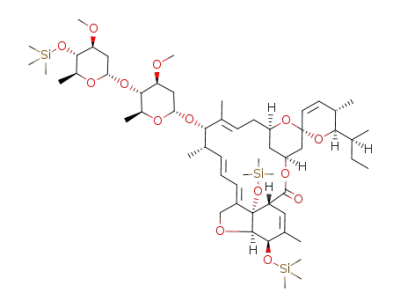
4'',5,7-tris-O-trimethylsilyl-avermectin B1
-
71826-88-5

4'',5-di-O-acetylavermectin B1a
-
65195-55-3
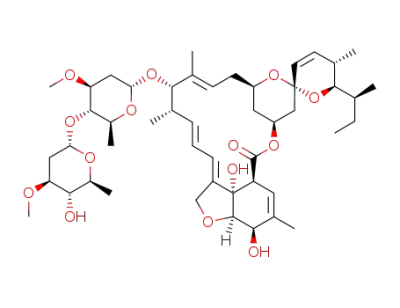
2-epiavermectin B1a
-
106621-62-9
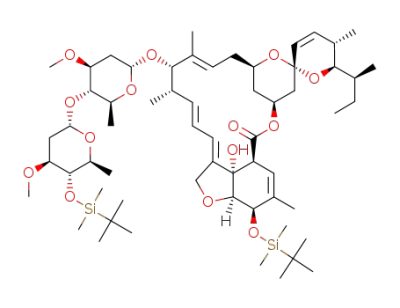
4'',5-bis
65195-55-3 Downstream products
-
116522-33-9
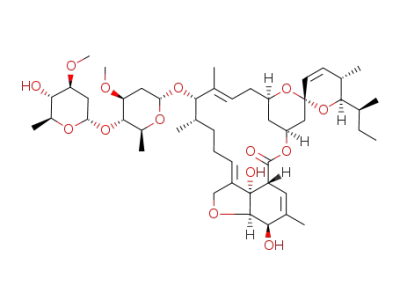
10,11-dihydroavermectin B1
-
71827-03-7
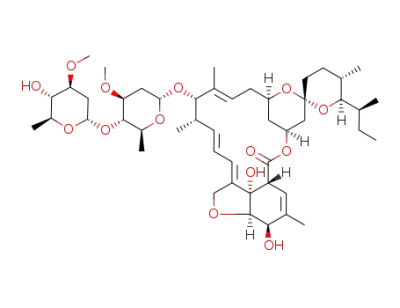
5-O-demethyl-22,23-dihydro-avermectin A1a
-
86629-72-3
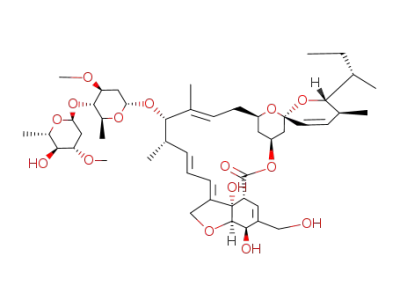
4a-hydroxyavermectin B1
-
71828-14-3
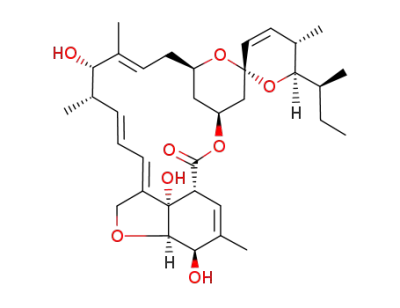
avermectin B1a aglycone